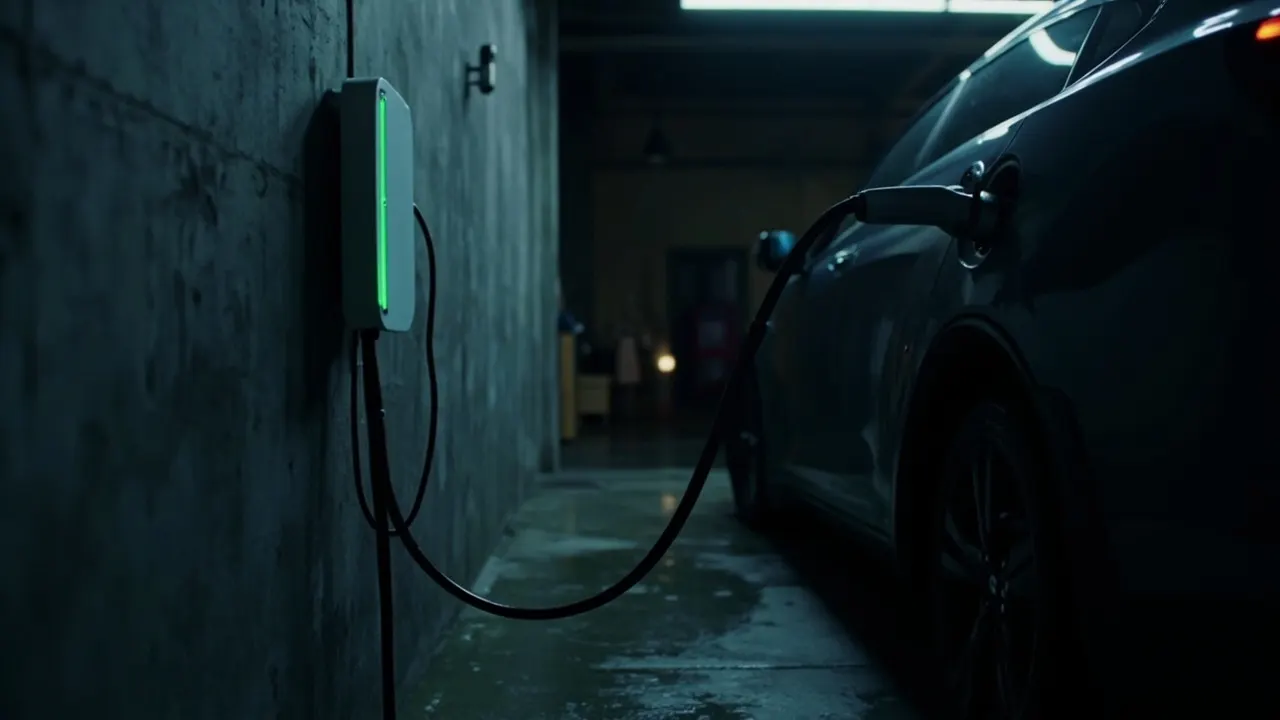
Tesla sells two wall chargers, and on everything that decides how fast a car charges they are the same unit. Both deliver up to 48 amps (11.5 kW) on a 60-amp circuit, both come with a 24-foot cable, both are hardwired, and both carry Tesla's four-year warranty at a single-family home. The difference is the plug. The Wall Connector has a NACS handle and nothing else. The Universal Wall Connector adds a J1772 adapter that docks on the side of the unit, so a car with the older J1772 port can charge without a separate adapter.
Tesla listed the Wall Connector at $585 and the Universal at $660 after a price rise that Not a Tesla App reported on 2026-09-17. Tesla's prices can change at any time, so check its shop before you budget.
The short answer
| Your household | Buy | Why |
|---|---|---|
| Only cars with a NACS port — any Tesla, every 2025 IONIQ 5 but the N, every 2025 EV6 but the GT | Wall Connector, $585 | Nothing here needs the J1772 adapter |
| A J1772 car that charges here every day | Universal, $660 | The adapter lives on the charger, not in a car |
| A J1772 car that only visits | Wall Connector plus a NACS-to-J1772 adapter | About $18 cheaper than the Universal today — the adapter |
| A Cybertruck, and you want Powershare home backup | Universal | Tesla's Cybertruck manual names it. With a Powerwall 3, either unit reportedly works |
| You can't hardwire, or a 14-50 outlet is already there | Neither — a plug-in charger | Both Tesla units are hardwired only — a plug-in alternative |
Side by side
| Wall Connector | Universal Wall Connector | |
|---|---|---|
| Tesla price (US) | $585 | $660 |
| Connector | NACS | NACS, plus a docked J1772 adapter |
| Maximum output | 48 A / 11.5 kW | 48 A / 11.5 kW |
| Breaker for full speed | 60 A | 60 A |
| Cable | 24 ft | 24 ft |
| Installation | Hardwired | Hardwired |
| Enclosure rating | Type 3R, IP54 | Type 3R, IP54 |
| Warranty at a single-family home | 4 years | 4 years |
| Warranty in an apartment, condo or shared spot | 1 year | 1 year |
| Cybertruck Powershare home backup | Reportedly, with a Powerwall 3 | Yes |
Look at what the extra $75 doesn't buy: speed. Both units share the same 48-amp ceiling and the same breaker table, both carry the same Type 3R and IP54 ratings for outdoor installation, and Tesla's warranty gives both 48 months at a single-family home. What you are paying for is the J1772 adapter on the side and, if you drive a Cybertruck, the charger Powershare home backup is built around. Tesla's Cybertruck manual lists "Cybertruck is connected to the Universal Wall Connector" among the conditions for Powershare to supply power. The charger is only part of that setup: Powershare also needs Tesla's Powershare Gateway, and Electrek puts the charger and gateway at around $4,000 installed. A home with a Powerwall 3 is the exception. Since September 2026 the Powerwall's own gateway can do that job, and Not a Tesla App reports that those homes can use either a Universal or a standard Wall Connector.
What circuit you need
Tesla's manuals for both units carry the same table. The installer programs the breaker size when commissioning the charger, and the charger never draws more than that circuit allows.
| Circuit breaker | Maximum output | Power at 240 V |
|---|---|---|
| 60 A | 48 A | 11.5 kW |
| 50 A | 40 A | 9.6 kW |
| 40 A | 32 A | 7.6 kW |
| 30 A | 24 A | 5.7 kW |
| 20 A | 16 A | 3.8 kW |
| 15 A | 12 A | 2.8 kW |
The 60-to-48 ratio comes from the National Electrical Code, which treats EV charging as a continuous load and requires the breaker to be rated at least 125% of the charger's maximum, so a charger can use only 80% of its circuit.
Before you pay for the heavier wire a 60-amp run needs, check what your car accepts, because the car sets the ceiling. Tesla's manuals note that some Teslas draw less than the charger's maximum, because the actual rate depends on the car's onboard charger. A 60-amp circuit only pays off if your car accepts 48 amps. And a smaller circuit goes further than it sounds: 7.6 kW for eight hours is about 60 kWh from the wall. Even after charging losses, that is well over 150 miles a night in a car using 300 Wh per mile.
What installation costs
Qmerit, which sells charger installations, puts the average Level 2 home installation at $1,700 in its 2026 data, within a range of $749 to $2,500. It names your panel's capacity and the charger's distance from the panel as the two biggest cost drivers. Permits add $50 to $800 depending on where you live, and if your home needs a service upgrade to 200 amps, Qmerit says to add $1,500 to $3,000. Tesla's manuals say the charger should only be installed by someone trained and qualified to work on electrical systems.
The federal credit that used to cover part of this is gone for new installs. The IRS's Form 8911 instructions say the 30C credit can't be claimed for refueling property, which includes home chargers, placed in service after June 30, 2026. Utility and state rebates are separate and still worth a search.
Don't buy either one on Amazon
Both chargers have Amazon listings under Tesla's name, and when we checked on 2026-10-28 neither had an Add to Cart button. The only offers you could buy came from third-party sellers: $884 and up for the Wall Connector, and about $935 to $940 for the Universal. That is roughly $275 to $300 over Tesla's price for the same hardware. Buy it from Tesla.
If a J1772 car will use it
There are two ways to charge a J1772 car from a Tesla charger, and at today's prices they cost almost the same.
The Universal keeps the J1772 adapter on the charger. Per Tesla's manual, you press a button on the adapter to take the handle out of its side dock, plug in, and dock it again when you're done. Nobody has to remember to bring it, because it lives on the charger rather than in a car.
The other route is the standard Wall Connector plus a NACS-to-J1772 adapter, which saves about $18 today. It suits a household where the J1772 car only visits, or where it will be replaced by a NACS car within a few years. Buy an adapter rated for at least the charger's 48 amps. A Wall Connector on a 60-amp circuit delivers its full output for hours, and a passive adapter can't tell it to slow down, so an under-rated adapter is the weak link in the circuit.

NACS-to-J1772 adapter for the standard Wall Connector
FOCSPROD for Tesla to J1772 Charger Adapter, Max 60A 250V for NACS to J1772 Electric Vehicles Charging Adapter Compatible with Tesla Mobile/Wall Connectors, Destination Chargers -UL 2252
- NACS-to-J1772 adapter rated up to 60A at 250V, for Tesla Wall Connectors, Mobile Connectors and Destination Chargers.
- AC Level 2 only: the listing says it does not work at Tesla Superchargers or other DC fast chargers.
- The listing says it is SGS-certified to the UL 2252 safety standard, and it has a security lock.
- Compact enough to keep in the car; FOCSPROD lists three years of customer support.
Pros
- + Rated 60A, above the Wall Connector's 48A maximum
- + The listing says it is SGS-certified to the UL 2252 adapter standard
- + Has a security lock, per the listing
- + Also works at Tesla Destination Chargers and on a Mobile Connector, per the listing
Cons
- − AC only — the listing says it won't work at Superchargers or other DC fast chargers
- − A loose part that can end up in the wrong car or the wrong drawer
- − At $56.99 (as of 2026-10-28), it saves only about $18 against the Universal
FOCSPROD's listing names both the safety standard, UL 2252, and the lab it says certified the adapter to it, SGS. Look for both on any adapter that will carry 48 amps for hours. For the same job away from home, our portable charger and adapter guide covers where these adapters work and where they don't, including why none of them work at a Supercharger.
If you can't hardwire: a plug-in NACS charger
Neither Tesla unit can plug into an outlet. The Universal's manual tells installers to hardwire the branch circuit and not to install cord-and-plug connections. If you rent, or a NEMA 14-50 outlet is already where you park, there are two plug-in routes. Tesla's own Mobile Connector delivers 32 amps (7.6 kW) with Tesla's NEMA 14-50 adapter, per its manual. Depending on when it was made, a Mobile Connector may not include that adapter, but Tesla sells one. A plug-in wall unit such as the Emporia delivers 40 amps on the same outlet, and converts to hardwired 48 amps if you add a 60-amp circuit later.

Plug-in alternative — Emporia NACS charger
EMPORIA Level 2 EV Charger - NEMA 14-50 EVSE w/NACS, Compatible with Tesla - 48 amp EV Charger Level 2, 240v Electric Vehicle Charging Station, UL/Energy Star, 25ft Cable, Black
- No Adapter Needed: Charge your Tesla or any vehicle requiring the NACS connection. Emporia's new NACS-specific ev charger works just like the Tesla charger, including remotely opening your Tesla charging port door at the press of a button.
- Up to 9x Faster Charging Speed: The Emporia electric vehicle charger provides up to 46 miles/hour charging speed via hardwired connection (48 amp - up to 9x faster than a standard wall outlet) or up to 38 miles/hour via the NEMA connection (40 amp).
- Versatile Installation Options: Preconfigured for NEMA Type 14-50P compliant with 2017 NEC Section 625.17 for up to 40A or convert to Hardwired for up to 48A. Professional installation recommended for optimal safety and performance.
- Safety, Certification, and Peace of Mind: UL listed and ENERGY STAR certified, meeting stringent standards (NEC 625, UL 817, UL 991, UL 2231, UL 2251, and UL 2594).
Pros
- + Ships with a NEMA 14-50 plug for 40A, or converts to hardwired 48A
- + Native NACS connector, like both Tesla units
- + Watertight NEMA Type 4 enclosure, a stricter rating than Tesla's Type 3R, per Emporia's spec sheet
- + UL listed and ENERGY STAR certified, per Emporia
- + $479 (as of 2026-10-28) — $106 less than the Wall Connector
Cons
- − Emporia recommends a non-GFCI breaker, but some local codes require one on a 14-50 outlet
- − NACS only, so a J1772 car still needs an adapter
- − Three-year warranty, where Tesla gives four at a single-family home
The Emporia makes the most sense where the hardwiring is the expensive part. A 14-50 outlet that is already installed costs nothing to reuse, and the unit can move with you. Check the outlet's breaker first: Emporia's spec sheet recommends a non-GFCI breaker to avoid nuisance tripping, and where local code requires a GFCI breaker on a 14-50 circuit, it recommends the hardwired version instead. Our Level 2 home charger guide compares it with other NACS and J1772 units, including cheaper 40-amp options.
An in-depth review of the Universal
Tom Moloughney's State of Charge channel used the Universal for a few weeks before reviewing it. The review includes a cable deep-freeze test, a connector drop test, an extreme-heat test and an automatic-restart test. It dates from September 2023, so treat any price in it as out of date. The video is sponsored by Qmerit, the installer quoted above.
Who can charge from it
Tesla's Universal manual lists four access settings. All Vehicles is the default: anything that plugs in can charge. Only Teslas admits any Tesla. Authorized Teslas Only admits the Teslas you add by VIN, during setup or in the Tesla app. Compatibility Mode is for older vehicles that fault on the charger.
That matters for a charger on an outside wall or a shared driveway. The VIN list only covers Teslas, so a household that also charges a non-Tesla can't use either Tesla-only setting, and any car that plugs in can charge. If that's your situation, mount it where it isn't reachable from the street. It can matter for the warranty too: Tesla's 48-month term covers charging at a single-family home, and its warranty counts a charger "located where users other than the owner could reasonably obtain access" as commercial use, which gets 12 months.
How to decide
- Count the ports, not the cars. If every car that will charge here has a NACS port, the standard Wall Connector does everything the Universal does. The one exception is Cybertruck Powershare in a home without a Powerwall 3.
- Check what your car accepts before you pay for a 60-amp run. A car limited to 32 amps charges just as fast on a 40-amp circuit, with cheaper wire.
- Get an installation quote before buying the charger. At Qmerit's $1,700 average, the installation can cost more than the charger, and a panel upgrade can add $1,500 to $3,000 on top.
- Buy from Tesla. Amazon's current offers for both units are hundreds of dollars over Tesla's price.
For Cybertruck owners weighing the Powershare setup, our Cybertruck guide covers the bed and cabin accessories, and our V2L guide explains what each EV's own outlets can run.
Sources
- Tesla — Universal Wall Connector installation manual, North America: specifications, breaker table, access settings, warranty
- Tesla — Gen 3 Wall Connector installation manual, North America: specifications, enclosure rating and breaker table
- Tesla — Gen 2 Mobile Connector owner's manual: 32-amp maximum on the NEMA 14-50 adapter, and that some units shipped without it
- Tesla — Cybertruck owner's manual, Powershare Home Backup
- Electrek — Cybertruck Powershare backs up homes with a Powerwall 3, September 10, 2026: Powershare Gateway and installed cost
- Not a Tesla App — Cybertruck and Powerwall can now power your home together, September 10, 2026: Powerwall 3 homes and the standard Wall Connector
- Not a Tesla App — Tesla shop changes, September 17, 2026: current US prices
- Qmerit — Level 2 EV charger installation costs in 2026: average cost, cost drivers, permits and panel upgrades
- EC&M — The apprentice's guide to Article 625: the continuous-load and 125% breaker rules
- Emporia — Classic Smart EV Charger spec sheet: enclosure rating and GFCI breaker guidance
- IRS — Instructions for Form 8911: end of the 30C credit