
If you already have a hardwired Level 2 charger bolted to your garage wall, you're covered at home. But EVs travel, and a charger that lives in one place doesn't help you at a rented cabin, your in-laws' driveway, or a job site with nothing but a dryer outlet. That's what a portable EVSE is for: a charger small enough to live in your trunk that plugs into whatever 120V or 240V outlet you can find, instead of one that's permanently wired to a single circuit.
The second half of this problem is connectors. North America is mid-transition from J1772 to NACS (the Tesla-style plug), and depending on what you drive, you may need an adapter — not a charger, just a shape-changer — to reach a charging network that wasn't built for your car's native plug. A Tesla can already reach thousands of J1772 stations with the right adapter; a J1772 EV can reach Tesla's non-Supercharger network the same way. We cover both below: portable chargers worth packing for the road, and adapters that unlock stations your car wasn't originally wired for.
Which of these do you actually need?
| Your situation | What decides it | Pick |
|---|---|---|
| Apartment or older house, ordinary sockets | 16A on a NEMA 5-15 or 6-20 — no new circuit | bokman 16A |
| Road trips, unknown outlets | Ships with both plug types | Raylix dual-plug |
| Want scheduling and cost tracking | 32A, WiFi app, needs a 40A circuit | AIMILER 32A |
| Tesla wanting to use a J1772 charger | Adapter, not a charger | J1772 to NACS |
| J1772 car wanting to use a Tesla connector | Adapter, for Tesla's AC chargers only | NACS to J1772 |
| CCS1 car wanting to Supercharge | A NACS-to-CCS1 DC adapter, not either adapter here | Why not |
| Charging mainly at home every night | None of these — a fixed unit is faster and cheaper per mile | Level 2 home chargers |
Who actually needs one of these
Not everyone does, so it's worth being honest about who benefits most:
- Renters and apartment dwellers without a dedicated garage circuit, who charge off whatever outlet the building allows.
- Road trippers and RV-park regulars who need something that plugs into a 14-50 pedestal outlet or a friend's dryer socket, not a fixed wall box.
- Two-home or seasonal owners who don't want to pay an electrician twice for a hardwired unit at a place they use six weeks a year.
- Anyone still waiting on an electrician for a permanent circuit and needs a bridge solution that also becomes a permanent backup afterward.
If none of that describes you, a hardwired home charger is still the better buy per dollar and per mile — it's just not portable.

EVDANCE Level 2 EV Charger 40Amp, 240V 9.6KW Portable Electric Vehicle Charging Stations with NEMA 14-50P, 25FT Cable Adjustable Current/Timing Delay Home Electric Car Charger for J1772 BEVs/PHEVs
- 8X Faster Charging: The EVDANCE ev charger level 2 comes with a NEMA 14-50 plug, charging at 240V and the maximum current can reach 40A, which can provide maximum 9.6kWh charging power. Experience unparalleled speed at approximately 8x faster than level 1 ev chargers
- Adjustable Charging Current: EVDANCE Level 2 charger supports adjustable currents settings ranging from 10A to 40A (10A/16A/20A/24A/32A/40A). Just touch the "A" button, you can easily select the appropriate charging speed to suit your specific needs
- Delayed Charging Function: With the delay start feature, you can set your charging time(delay 1-12 hrs), staggering the peak usage period and reducing your energy costs
- Intelligent 2.4"" TFT Display & & LED Indicators: Our 40A electric car charger equipped with a large 2.4"" TFT screen, it provides clear and real-time charging information, including charging current/voltage/power kWh, charging time and work status, etc.The LED indicator on the control box provides real-time charging status
The EVDANCE 40A hits the mark for a do-it-all portable unit: a real 9.6kW/40A ceiling on a NEMA 14-50 plug, adjustable current down to 10A for weaker circuits, a delay timer for off-peak charging, and an IP66-rated housing with a carry bag so it survives actually living in a trunk. At $176.98 it undercuts most mid-tier home chargers, but it goes wherever your car does — the tradeoff most drivers should make before spending more on a fixed installation they can't take with them.
The picks at a glance
EVDANCE Level 2 EV Charger 40Amp, 240V 9.6KW
$176.98 as of 2026-10-14
- Max amps
- 40A (10-40A adjustable)
- Connector
- J1772
- Plug
- NEMA 14-50
- Cable
- 25 ft
bokman Portable Level 1&2 EV Charger, 16A 20ft
$106.99 as of 2026-10-14
- Max amps
- 16A
- Connector
- J1772
- Plug
- NEMA 6-20 / 5-15
- Cable
- 20 ft
2026 Upgraded Level 1&2 Portable EV Charger
$109.99 as of 2026-10-14
- Max amps
- 16A (8-16A adjustable)
- Connector
- J1772
- Plug
- NEMA 5-15 / 6-20
AIMILER Level 2 Electric Vehicle (EV)
$179.99 as of 2026-10-14
- Max amps
- 32A (16-32A adjustable)
- Connector
- J1772
- Plug
- NEMA 14-50
- Cable
- 25 ft
Lectron J1772 to Tesla Adapter 80 Amp (240V)
$39.99 as of 2026-10-14
- Max amps
- 80A
- Connector
- J1772 to NACS
FOCSPROD for Tesla to J1772 Charger Adapter
$56.99 as of 2026-10-28
- Max amps
- 60A
- Connector
- NACS to J1772
Prices move around on Amazon — the table shows what we last recorded, and each "Check price" button takes you to the live listing.
Best budget: bokman 16A
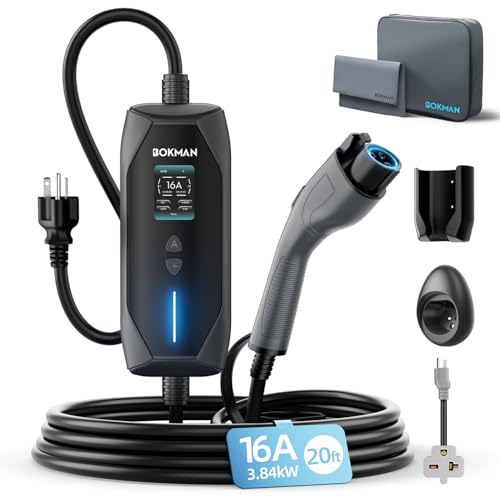
Best budget
bokman Portable Level 1&2 EV Charger, 16A 20ft, NEMA 6-20P/5-15 Adapter
- Lightweight & portable with a 20-foot cable: About the length of a parking space with room to spare - perfect for apartments, older homes, and road trips. Includes NEMA 5-15 adapter
- Delay timer & adjustable current: Use the built-in timer to delay start by 1-12 hours, so charging begins during off-peak hours when electricity is cheaper. Then pick from 6/8/10/12/16A (Level 2). No complicated apps or Wi-Fi needed - just straightforward, reliable control
- Easy-to-Use Physical Buttons: Unlike finicky touchscreens that fail in rain or cold, our EV charger has tactile buttons. Set current and delay timer without looking. Reliable scheduling in any weather
- Safety & Durability First: ETL certified for electrical safety. IP65 waterproof for outdoor use. Overheat, voltage, current, and ground fault protection. Survives 1M drops and 2T of vehicle pressure. No melting wires or stuck connectors.
Pros
- + Cheapest full charger here at ~$107 — only the two adapters cost less
- + Dual-level: NEMA 6-20 (Level 2) plus an included 5-15 adapter (Level 1)
- + Physical buttons — no app, no Wi-Fi dependency to fail in the cold
- + ETL certified, IP65 rated for outdoor use
Cons
- − 16A ceiling — noticeably slower than the 32-40A units here
- − 20ft cable is shorter than some home chargers, so parking matters more
If your trip math is "get to 60% by morning," you don't need 40A — you need something cheap, reliable, and small enough to forget it's in your trunk until you need it. The bokman skips smart features entirely and just charges, at up to 16A on a 240V circuit or Level 1 speeds on any ordinary outlet. Tactile buttons instead of a touchscreen also mean it keeps working in a frozen parking lot at midnight, which is exactly when a portable charger earns its keep.
Best for any outlet you find: Raylix 2026 dual-plug

Best travel flexibility
2026 Upgraded Level 1&2 Portable EV Charger, 8-16Amp Adjustable Current & Timer, 110V-240V, NEMA 5-15 & 6-20 Plug, 21Ft EV Charging Cable, J1772 Electric Car Charger for All PHEV/EV Charging Cord
- [2026 INTELLIGENT CHARGING UPGRADE — PRECISION CONTROL MEETS SMART SCHEDULING] After surveying 100K+ U.S. EV owners, the Raylix R&D team found that nearly all drivers recognized the necessity of adjustable current and scheduled charging. Our upgraded J1772 charger features 4-level adjustable current (8A/10A/12A/16A) and a 1–12 hour smart delay timer.
- [ONE CHARGER, ALL J1772 EVs/PHEVs READY!] Compatible with all SAE J1772 electric vehicles and plug-in hybrids—whether it's Ford, GM, Nissan, Audi, BMW, Kia, Hyundai, Honda, Chevy, or more. Perfect for home or on-the-road charging.
- [CHARGE 4× FASTER — NO MORE WAITING] Our 16A Level 1 & 2 charger delivers charging speeds up to 4× faster than standard 8A Charger Level 1.
- [LEVEL 1 & 2 PORTABLE CHARGER — CHARGE ANYWHERE, ANYTIME] Raylix Level 1 & 2 EV charger features both 5-15 and 6-20 plug compatibility. NEMA 6-20 plug for Level 2 ev charging (240V, 16A, 3.68kW, 9-12 miles/hr) and a NEMA 5-15 adapter for Level 1 ev charging (120V, 12A, 1.44kW, 3-5 miles/hr)
Pros
- + Both NEMA 5-15 (120V) and 6-20 (240V) plugs included in the box
- + Adjustable 8-16A current with a smart 1-12hr delay timer
- + TFT display shows voltage, current, and temperature at a glance
- + Compact and genuinely travel-ready at ~$110
Cons
- − 16A ceiling caps Level 2 speed well below the 32-40A units
- − Lower power means noticeably longer charge times on the road
This is the one to keep in the car if you genuinely don't know what you'll be plugging into next. It ships with both a standard household plug and a 240V dryer-style plug, so it adapts to whatever outlet you find rather than requiring you to hunt one down first. You give up top-end speed for that flexibility — 16A tops out well below the 40A chargers here — but for occasional backup charging, having any outlet work beats having the fastest outlet work.
Best smart / app-connected: AIMILER 32A

Best app control
AIMILER Level 2 Electric Vehicle (EV) Charger(WIFI APP/Plug-play), 32A, 25ft Cable ETL Certified, 220V-240V NEMA 14-50P Plug EVSE w/ J1772 Connector, Portable EV Car Charging Stations for Home Level 2
- [Equipped with Nema 14-50 plug 240V, Compatible with 110-120V Nema 5-15p to 14-50r EV Adapter(Not packaged) or the other EV Adapter Cable]: Suggest install the 240V Nema 14-50 plug-in socket.
- [Features a J1772 Connector for All North America J1772 EVs/PHEVs. For Tesla EVs/Nacs Connector Cars, This will Require an j1772 to Tesla Adapter]: 6X Faster Charging with ETL, FCC Listed, Meets the Safety Criteria Defined by: SAE J1772, UL2231-1/-2, UL 991, UL 2231, UL 2251, UL1998 and UL 2594
- [Up to 7.68kWh High Speed Charging, Adjustable Amperage from 16A to 32A & Requires a 20A to 40A circuit]: Maximum current output of 32 Amps for 40A circuit breaker, 24 Amps for 30A circuit breaker, or 16 Amps for 20A circuit breaker
- [2 Operating Modes: Plug-charge(The Default Setting) or APP Start Mode & Smart Touch Screen]: The LED Screen Clearly show the Amperage, charging speed, input voltage, delay time, etc.
Pros
- + 32A / up to 7.68kW on a NEMA 14-50 plug
- + WiFi app for scheduling and charge history
- + ETL certified against UL-referenced safety standards
- + Touchscreen plus a simple plug-and-charge mode with no app required
Cons
- − Requires a 240V NEMA 14-50 outlet — no Level 1 fallback
- − The smart scheduling features need an app account to unlock
The AIMILER is the pick if you want your portable charger to behave like a home unit — schedule sessions around off-peak utility rates, check history in the app, get a notification when it's done — but still be able to toss it in the trunk for a road trip. It gives up the dual-level flexibility of the Raylix in exchange for real Level 2 speed and a much more capable feature set.
Adapters: crossing the J1772 / NACS divide

Best for Tesla owners reaching J1772 stations
Lectron J1772 to Tesla Adapter 80 Amp (240V) - EV Charging Adapter Compatible with Tesla Model S/3/X/Y/Cybertruck and All Electric Vehicles in the NACS Alliance (Black)
- VERSATILE CHARGING SOLUTION - Expand your charging options and access any J1772 chargers with the Lectron J1772 to Tesla Adapter
- WIDE COMPATIBILITY - This adapter is compatible with all Tesla models and EVs in the NACS alliance. It supports Level 1 and Level 2 charging, allowing you access to a broader range of charging locations, whether you're at home, work, or on the road
- ROBUST PERFORMANCE - This J1772 to Tesla NACS adapter supports 240V AC and handles up to 80A of current. It has an operating temperature ranging from -22°F to 122°F (-30°C to 50°C), providing reliable charging in any condition
- PLUG & PLAY DESIGN - Light, compact, and easy to use, this J1772 to Tesla adapter fits easily in your glove box. Simply plug it into any SAE J1772 charger and connect it to your Tesla to start charging

Best for J1772 EV owners reaching Tesla stations
FOCSPROD for Tesla to J1772 Charger Adapter, Max 60A 250V for NACS to J1772 Electric Vehicles Charging Adapter Compatible with Tesla Mobile/Wall Connectors, Destination Chargers -UL 2252
- NACS-to-J1772 adapter rated up to 60A at 250V, for Tesla Wall Connectors, Mobile Connectors and Destination Chargers.
- AC Level 2 only: the listing says it does not work at Tesla Superchargers or other DC fast chargers.
- The listing says it is SGS-certified to the UL 2252 safety standard, and it has a security lock.
- Compact enough to keep in the car; FOCSPROD lists three years of customer support.
The Lectron J1772-to-Tesla adapter lets a Tesla or other NACS-native EV plug into the tens of thousands of J1772 Level 2 stations — hotels, public garages, workplace chargers — that haven't converted to NACS yet. Rated for 80A/240V with an IP67 weatherproof rating and UL 2251 certification, it's cheap insurance at $39.99 that every Tesla owner traveling outside a Supercharger corridor should keep in the frunk.
Going the other direction, the FOCSPROD NACS-to-J1772 adapter lets J1772 EVs plug into Tesla Wall Connectors, Destination Chargers, and Mobile Connectors — a huge and still under-used charging network for non-Tesla drivers. It's rated for 60A/250V and UL 2252 certified. Choosing a home charger for a household with both plug types? Our Wall Connector vs Universal guide works out whether this adapter or Tesla's Universal Wall Connector is the better buy.
Does a NACS-to-J1772 adapter work at a Supercharger?
No. A NACS-to-J1772 adapter carries AC power only, and a Supercharger delivers DC, so a car never fast charges through one. FOCSPROD's listing says so outright: "Not compatible with Tesla Superchargers or DC Fast Charge." The Lectron adapter, going the other way, is AC-only too.
To Supercharge, a car with a CCS1 port needs a NACS-to-CCS1 DC adapter, and its automaker needs Supercharger access; Hyundai and Kia supply their own adapters to CCS1 owners. Cars with a factory NACS port, such as the 2025 IONIQ 5 and every 2025 EV6 but the GT, plug in without one. On a Hyundai you start the session in the Tesla app, and on a Kia through the Kia Access app.
A small number of Supercharger stalls have a CCS1 adapter built into the handle, which Tesla calls Magic Dock, so CCS cars can DC fast charge there without carrying one. They're the exception. The Juice Index counted fewer than 180 US sites with Magic Dock as of late 2025, out of roughly 3,100, and reports that Tesla slowed the rollout once most automakers adopted NACS. Stations that have one list CCS as a connector in the Tesla app.
How to choose
- Match amperage to your circuit, not your ambition. A 40A charger on a 20A circuit just runs at 16A — check your outlet's breaker rating before assuming you'll get the number printed on the box.
- Dual-level (Level 1 + Level 2) units trade top-end speed for flexibility. You're never stuck without options since any 120V outlet works, just slowly — a reasonable trade for an occasional-use travel charger.
- Weight and cable length matter more for units that live in a trunk. A compact housing with a carry bag beats a home-charger-sized box you're wrestling into a hatchback every time you use it.
- Adapters don't add power. A 48A car on a 32A-rated adapter still only gets 32A — match the adapter's rating to what you actually need, with some headroom for whatever you charge on next.
- Check certification, not just price. UL 2251/2252 (J1772/NACS adapters) and UL 2231/2594 (EVSEs) aren't optional extras — this hardware carries real current at 240V, and the cheapest unlisted option is a genuine fire-safety gamble.
None of this replaces a home Level 2 charger if you have the option to install one — it's faster and cheaper per mile there, every time. But for the miles you drive away from your own garage, one of these six is worth keeping within reach.
If what you need is power from the car rather than into it, to run lights or tools at a campsite, that is a different question. What each EV can put out covers it model by model.
Sources
- SAE J3400 (NACS connector standard) — the standard behind NACS-to-J1772 adapter compatibility
- US DOE Alternative Fuels Data Center — Level 1 vs Level 2 charging rates
- The Juice Index: Tesla Magic Dock explained — Magic Dock site counts and how to find them
- Hyundai: NACS adapter FAQs — the adapter a CCS1 Hyundai needs at a Supercharger, and starting the session in the Tesla app
- Kia America: Supercharger access for Kia EVs, April 24, 2025 — NACS-to-CCS1 adapters through dealers, the Kia Access app, and the 2025 EV6's factory NACS port