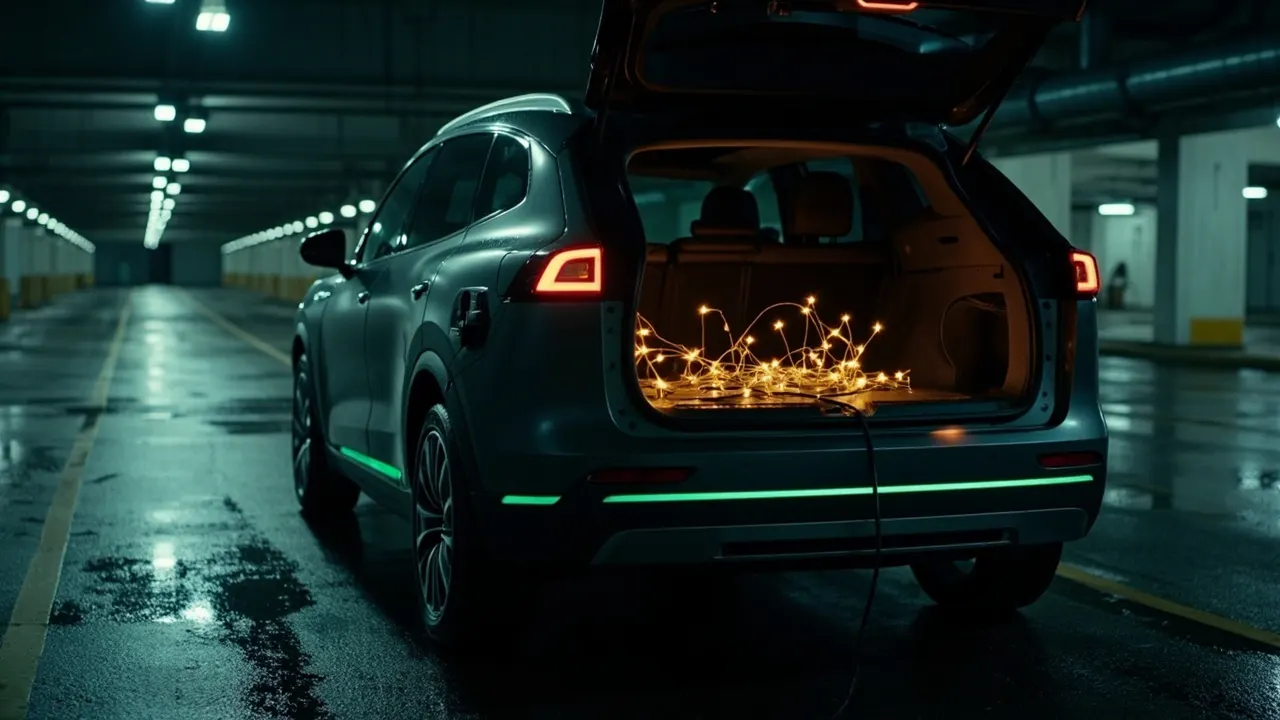
Trunk-or-treat is the one night of the year where an electric car is straightforwardly the better vehicle to own. No idling, no exhaust drifting across a car park full of children, no generator noise competing with the music — and, on some EVs, a genuine household outlet to run the whole display from.
The trouble is that every trunk-or-treat guide on the internet tells you to "plug your decorations into your car's power outlet", and for the two best-selling EVs in America that advice is simply wrong. A Model Y has no outlet to plug into. Neither does a Mach-E, and no adapter will ever give it one.
So before buying anything, find out what your car can actually put out. That number varies by more than a factor of sixty across cars people think of as interchangeable.
What your EV can actually put out
| Your EV | AC power export | What that runs |
|---|---|---|
| Ioniq 5 / 6 / 9, EV6, EV9, Genesis | V2L via charge-port adapter, 1.9 kW | Essentially anything |
| Cybertruck AWD / Cyberbeast | Powershare, built in, up to 9.6 kW | Anything, no adapter needed |
| F-150 Lightning | Pro Power Onboard, 2.4 kW or 9.6 kW | Anything, no adapter needed |
| Rivian R1T / R1S | Built-in 120 V outlets | Most things, no adapter needed |
| Model 3 / Y / S / X | None. 12 V socket only | Lights only, or bring a battery |
| Mustang Mach-E | None, and not fixable | Lights only, or bring a battery |
| Bought a 2025 or newer Hyundai/Kia | V2L, but a different plug | Read this before ordering |

HITRENDS J1772 V2L Adapter, Vehicle to Load Adapter with 1250W 6-Outlet Power Strip and USB, 14.7 ft Cable, Compatible with J1772 Port EVs
- Six-outlet power strip with USB on a 14.7 ft cable, rather than a single socket at the charge port.
- Listed at up to 1250 W (125 V / 10 A).
- Stated UL94V-0 flame-retardant housing and an IP55 rating when connected, with overload protection.
- Named for J1772 cars: Ioniq 5 and 6, Kia EV6 and Niro EV, and Genesis electric models.
The picks at a glance
| Product | Rated output | Works with | ||
|---|---|---|---|---|
| V2L Adapter Compatible with Hyundai IONIQ 5 & | $49 as of 2026-09-16 | 15 A max | J1772: Ioniq 5/6 (EV6 claim conflicts) | Check price → |
| EVDANCE V2L Adapter Compatible with Hyundai | $79.99 as of 2026-09-16 | 15 A max | J1772: Ioniq 5/6, EV6 | Check price → |
| HITRENDS J1772 V2L Adapter, Vehicle to Load | $94.99 as of 2026-09-16 | 1,250 W (125 V / 10 A) | J1772: Ioniq 5/6, EV6, Niro EV, Genesis | Check price → |
| Jicxv NACS V2L Adapter-Vehicle to Load Adapter | $119.99 as of 2026-09-16 | Not stated | NACS: 2025+ Ioniq 5/6/9, 2026+ Kia EV3/5/6/9 | Check price → |
| ALLWEI Portable Power Station 300W, 256Wh Solar | $128.99 as of 2026-09-16 | 300 W cont. / 600 W peak | Any vehicle — self-powered | Check price → |
| GRECELL 999Wh Portable Power Station 1000W for | $379.99 as of 2026-09-16 | 1,000 W cont. / 2,000 W peak | Any vehicle — self-powered | Check price → |
Prices move around on Amazon — the table shows what we last recorded, and each "Check price" button goes to the live listing.
If you drive an Ioniq 5, Ioniq 6, EV6 or EV9
You own the best power source in the car park and you probably already know it. Hyundai's E-GMP platform runs its onboard charger in reverse, so the charge port becomes a household outlet with nothing more than a passive adapter. Hyundai rates the US 120 V connector at 1.9 kW. There is a second outlet under the rear seat on most trims, which is the one to use if the cable would otherwise run around the side of the car.
One number worth getting straight, because the listings invite confusion: most of these adapters advertise 15 A, which at 120 V would be 1,800 W. That is the adapter's rating, not the car's. The vehicle caps the draw regardless, so the lower number is the one that binds. Buying a higher-rated adapter does not buy you more power.
Best overall — HITRENDS six-outlet
HITRENDS J1772 V2L Adapter, Vehicle to Load Adapter with 1250W 6-Outlet Power Strip and USB, 14.7 ft Cable, Compatible with J1772 Port EVs
- Six-outlet power strip with USB on a 14.7 ft cable, rather than a single socket at the charge port.
- Listed at up to 1250 W (125 V / 10 A).
- Stated UL94V-0 flame-retardant housing and an IP55 rating when connected, with overload protection.
- Named for J1772 cars: Ioniq 5 and 6, Kia EV6 and Niro EV, and Genesis electric models.
Pros
- + A six-outlet strip with USB on a 14.7 ft cable, rather than a single socket sitting at the charge port
- + The cable length is the actual feature — you can reach the far side of a boot display without a second extension lead
- + Stated UL94V-0 flame-retardant housing and an IP55 rating while connected, with overload protection
- + The broadest compatibility list here: Ioniq 5 and 6, EV6, Niro EV and Genesis electrics
Cons
- − Rated at 1,250 W (125 V / 10 A) — lower than the 15 A adapters and below what the car could supply
- − $94.99 (as of 2026-09-16) is near the top of the J1772 range
- − J1772 only, so it will not fit a 2025-or-newer Hyundai or Kia
This is the one to buy if you intend to actually run something. Every other adapter here terminates in a single socket at the charge port, which means your first purchase afterwards is an outdoor extension lead and a power strip anyway. This arrives as both, on a 14.7 ft cable, in a housing rated to sit outside while it works.
The trade is honest and worth weighing: at 1,250 W it is rated below the 15 A adapters and below what the car can deliver. For lights, a speaker and a projector that is irrelevant. If you were planning to run a 1,500 W heater, it is not the adapter you want.

Best plain adapter — EVDANCE
EVDANCE V2L Adapter Compatible with Hyundai Ioniq 5 & Ioniq 6, Kia EV6 15 Amp Vehicle to Load Adapter for Outdoor
- Turns the car's J1772 charge port into a standard NEMA 5-15 household outlet.
- Listed at a maximum 15 amp output.
- Named for the Hyundai Ioniq 5 and Ioniq 6 and the Kia EV6; the listing states it is not compatible with other EV models.
- EVDANCE includes a stated 1-year warranty.
Pros
- + 15 A rating, the highest stated here, and it names the Kia EV6 in the compatibility bullet rather than only in the title
- + EVDANCE states a 1-year warranty, which none of the cheaper adapters here offer
- + Glovebox-sized, so it lives in the car instead of being remembered on the way out
- + $79.99 (as of 2026-09-16)
Cons
- − A single NEMA 5-15 socket at the charge port — you will want an outdoor extension lead as well
- − $31 more than the near-identical budget adapter, for a warranty and a clearer compatibility claim
- − J1772 only
If you would rather have the higher rating and supply your own extension lead, this is the pick. Functionally it is the same passive adapter as the $49 one below; what you are paying for is the stated warranty and a compatibility list that actually names the EV6 in the body of the listing.

Cheapest way in
V2L Adapter Compatible with Hyundai IONIQ 5 & IONIQ 6, Kia EV 6. Power Your Devices by Using Your Car Battery, for Camping, Emergency Use
- Converts the J1772 charge port into a NEMA 5-15 outlet with no installation.
- Listed at a 15 amp maximum output.
- The title names the Kia EV6, but the compatibility bullet lists only the Ioniq 5 and 6 and says it is not compatible with other EVs.
- Lightweight and glovebox-sized.
Pros
- + $49.00 (as of 2026-09-16), the lowest price here for a working J1772 V2L adapter
- + Same 15 A stated rating as the EVDANCE
- + Compact enough to leave in the glovebox permanently
Cons
- − The listing contradicts itself: the title says "Kia EV 6", but the compatibility bullet lists only the Ioniq 5 and 6 and then says it is not compatible with other EVs
- − No stated warranty
- − Single socket, J1772 only
Worth buying if you have an Ioniq 5 or 6 and want the capability for the lowest outlay. We would hesitate to recommend it to an EV6 owner specifically, and the reason is the listing rather than the hardware: the title claims the EV6 and the compatibility bullet does not. That contradiction is the seller's to resolve, not ours to paper over, and an EV6 owner is better served by the EVDANCE or the HITRENDS, both of which name the car properly.
The port changed in 2025, so check yours first
This is the detail most likely to cost you money this year, and almost nothing written about V2L mentions it.
Hyundai and Kia have moved to the NACS charge port. The adapters above — and the great majority of V2L adapters you will find, because the category has been J1772 for years — physically will not fit a 2025-or-newer car. Two Ioniq 5s a model year apart take different adapters.
Do not reason from the model year or the badge. Look at the port. J1772 is the older, larger rectangular connector with a flat top edge; NACS is the smaller, rounder Tesla-style connector.

If your car has a NACS port
Jicxv NACS V2L Adapter-Vehicle to Load Adapter for 2025+ Ioniq 5/6/9, 2026+ Kia EV3/5/6/9, 2025+ Genesis (Requires V2L+NACS Inlet), Safety Lock, LED Display
- For NACS-port cars, which is what Hyundai and Kia switched to — a J1772 adapter will not fit these.
- Turns the NACS charge port into a NEMA 5-15 outlet.
- LED display reports status, live discharge power in kW, and total energy used.
- Locks into the charge port during use to prevent accidental disconnection or theft.
Pros
- + Fits the cars the J1772 adapters cannot: 2025+ Ioniq 5, 6 and 9, 2026+ Kia EV3, EV5, EV6 and EV9, and 2025+ Genesis
- + An LED display reporting live discharge power in kW and cumulative energy used, which no other adapter here offers
- + Locks into the port during use, so it cannot be pulled out or walked off with
Cons
- − $119.99 (as of 2026-09-16), the most expensive adapter here
- − The listing does not state a maximum output figure at all, where every J1772 adapter here does
- − Requires the car to have both a NACS inlet and V2L — the listing is explicit that both are needed
There is no real choice to make here: if your car has a NACS port, this is the category, and the premium over a J1772 adapter is the price of the newer standard rather than a better product. The live kW readout is genuinely useful at an event, because it turns "is this too much?" into a number you can look at.
If you drive a Tesla or a Mach-E
The honest answer is that your car is not going to power your display, and the sooner you accept that the better your night goes.
No Model 3, Model Y, Model S or Model X has vehicle-to-load. There is no inverter in the car and no adapter that can add one — the same is true of the Mustang Mach-E, where Ford simply did not fit the hardware and the charge port's DC pins are not wired to send power outward. Adapters sold as fixes for this cannot work, because what is missing is hardware.
What you have instead is the 12 V accessory socket. Tesla's own guidance puts it at around 12 A continuous, which is roughly 150 watts. And on the Model 3 and Y it is not a fuse but an electronic circuit breaker: draw too much and the car quietly cuts the socket, then resets when the overload clears.
That matters because the product Amazon will sell you for this job is a 300 W inverter, at around $20 to $39. Plugged into a 150 W circuit and asked to do 300 W of work, it will trip the breaker. The most-recommended accessory for the problem is rated at twice what the most common EV can supply. We have not included one here, because recommending a part that exceeds the circuit it plugs into would be recommending a fault.
The fix is to stop trying to draw from the car.

Enough for lights and sound
ALLWEI Portable Power Station 300W, 256Wh Solar Generator LiFePO4 Battery
- 256 Wh LiFePO4 pack rated 300 W continuous and 600 W peak, pure sine wave.
- One AC outlet plus USB-C PD 60 W, USB-A, two DC5521 and a 12 V car port.
- 6.4 lb and roughly the size of a shoebox.
- Stated 3000 charge cycles; recharges from AC in 3.5-4 hours.
Pros
- + 300 W continuous and 600 W peak from a 256 Wh LiFePO4 pack — comfortably more than the car's socket
- + 6.4 lb and shoebox-sized, so it sits in the frunk without taking the frunk
- + Pure sine wave, with USB-C PD 60 W and a 12 V car port alongside the AC outlet
- + $128.99 (as of 2026-09-16) — cheaper than every V2L adapter here except the budget one
Cons
- − 256 Wh is a real ceiling: a 250 W draw empties it in about an hour
- − One AC outlet, so a power strip is still on the shopping list
- − Recharges in 3.5-4 hours, which means remembering it the night before
For a boot full of LED string lights and a Bluetooth speaker, this is the right size and the right price. It is also the one that stays useful the rest of the year, because it is small enough to keep in the car rather than in the garage.

Enough for anything
GRECELL 999Wh Portable Power Station 1000W for Outdoor & Home Backup
- 999 Wh LiFePO4 pack rated 1000 W continuous and 2000 W peak through a pure sine wave inverter.
- Two 110 V AC outlets plus USB-C PD 60 W, three USB-A, and a 10 W wireless pad.
- Recharges from a wall outlet, from solar, or from a 12 V car port.
- Stated 2000+ charge cycles, and 17 lb with a carry handle.
Pros
- + 999 Wh and 1,000 W continuous, 2,000 W peak — runs an inflatable blower, a fog machine and lights together
- + Two AC outlets plus USB-C PD, three USB-A and a wireless pad, so the power strip may be unnecessary
- + Stated 2,000+ charge cycles on LiFePO4, and it recharges from the car's 12 V port between uses
- + Roughly matches what an Ioniq 5 delivers over V2L, from a 17 lb box
Cons
- − $379.99 (as of 2026-09-16) — five times the cost of a V2L adapter, which is what an Ioniq 5 owner pays for the same capability
- − 17 lb is portable but not casually so
- − Overkill if all you are running is lights
This is the pick that closes the gap. At 999 Wh and 1,000 W it does roughly what an Ioniq 5 does through its charge port, which is the clearest way to see what Tesla and Ford owners are actually buying: about $380 worth of battery to replace a capability that costs an Ioniq 5 owner $49 in adapter.
Worth saying plainly — if you are not doing this more than once a year, borrow one. The value here is in owning it for outages and camping, not for one night in October.
If you drive a Lightning, Cybertruck or Rivian
Buy nothing. You already have outlets, and this is the section where the correct advice is to stop reading.
The F-150 Lightning has Pro Power Onboard, 2.4 kW as standard and 9.6 kW optional, with sockets in the bed and in the frunk. The Cybertruck AWD and Cyberbeast carry Powershare: two 120 V outlets in the cabin, two more plus a 240 V socket in the bed, up to 9.6 kW. The Rivian R1T and R1S have 120 V outlets in the bed and gear tunnel; InsideEVs puts the shared output at about 1,500 W, which is the figure to plan against until Rivian states one directly.
All three will run a trunk-or-treat display without noticing. The only thing worth buying is a decent outdoor-rated extension lead, and you likely own one.
Our F-150 Lightning, Cybertruck and Rivian camping guides cover the accessories that are worth money on these trucks.
Hauling the candy
One product that applies regardless of what your car can power, and the only one here a Model Y owner can use without a battery.

For the frunk
Frunk Cooler Organizer for Tesla Model Y 2020-2026, Insulated Waterproof Front Trunk Storage Bag with Hidden Pocket, 2-Pack Black
- Two-piece set cut for the Model Y frunk, 2020-2026.
- Three-layer build: 600D Oxford shell, EPE foam insulation, waterproof lining.
- Zippered lid with a hidden pocket; holds temperature hot or cold.
- Collapses flat when not in use.
Pros
- + Two insulated bins cut for the Model Y frunk, so the space gets used rather than becoming a well things roll around in
- + Waterproof lining and a zippered lid — the relevant feature when the candy is in a car park in late October
- + Collapses flat, so it is not a permanent tenant
- + $69.99 (as of 2026-09-16) for the pair
Cons
- − Model Y specific, 2020-2026 — not a universal organiser
- − $69.99 is a lot for two bags if all you want is somewhere to put sweets
- − No brand stated on the listing
Insulated and waterproof is doing real work here rather than being spec-sheet filler: chocolate in a sealed car on a warm afternoon is a known way to ruin a boot liner. If you want the boot covered as well, our Model Y floor mat guide has the cargo liners.
What to do with this
If you have a Hyundai or Kia, buy the adapter that matches your port and stop thinking about it — it is a $49 to $120 purchase that makes the car materially more useful for camping, tailgating and outages, and Halloween is just the excuse to finally do it.
If you have a Tesla or a Mach-E, the car is not part of this. Decide between a 300 Wh battery for lights and a 1,000 Wh one for everything, and size it against what you are actually running rather than what you might.
If you have one of the trucks, you were already fine.
And whichever you have: work out the total wattage before the night, not during it. Every failure mode here is the same failure mode — something drew more than the source could give, in the dark, with an audience.