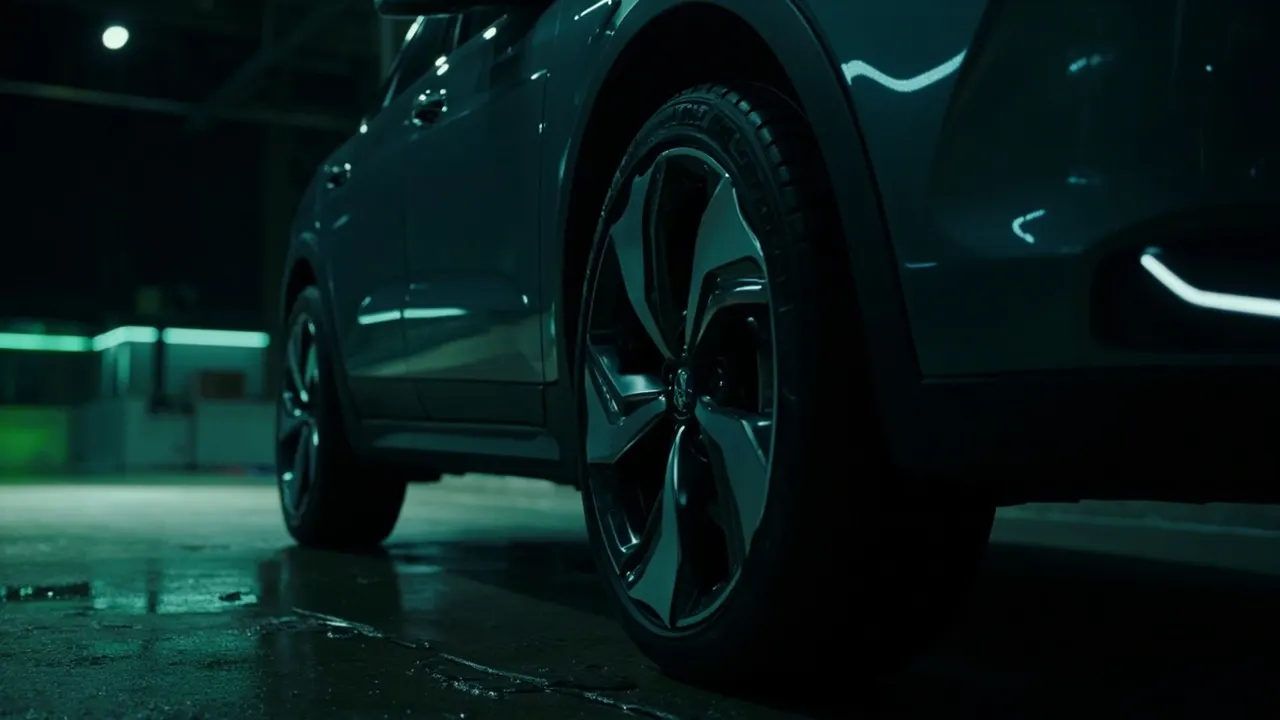
Tires are the one EV upgrade that moves range in both directions. Fit the wrong set and you can quietly lose efficiency you paid a lot of money for; fit the right set and you get some of it back, plus a noticeably quieter cabin. The category is also thick with marketing, because putting "EV" on a sidewall is cheap and charging a premium for it is easy.
Here's what genuinely differs on an EV tire, which of the current EV-specific lines are worth the money, and — the part most roundups skip — when you're better off buying a good conventional tire instead.
What are you actually driving?
| Your car | What decides the tyre | Pick |
|---|---|---|
| Model 3, Model Y RWD or Long Range | Efficiency — rolling resistance is where range is won | Michelin e.Primacy |
| Any EV where cost per mile is the point | Lowest price of the four, still an EV-specific line | Bridgestone Turanza EV |
| Model Y Performance, Ioniq 5, EV6, Ariya, Lyriq | Load rating — a crossover EV is 20-30% heavier than its petrol equivalent | Hankook iON evo AS SUV |
| Anything where cabin noise bothers you | Foam liner, because there is no engine to mask road roar | Goodyear ElectricDrive 2 |
| A car still on its factory tyres | Nothing yet — the OE set is usually already EV-specific | When these aren't worth it |
Check the size stamped on your current tyre before anything else. Every pick here comes in several fitments, and the wrong size fits nothing.
Three things that actually differ
Load rating, and this one isn't a preference
An EV is often 20–30% heavier than a comparable gas car, because the battery pack weighs what it weighs. That extra mass has to be carried by four contact patches. You'll see XL (Extra Load) on most EV fitments and increasingly HL (High Load), a newer designation that carries more weight at the same inflation pressure. If your car shipped on HL, dropping to XL is a real reduction in capacity even when the size digits match.
Rolling resistance, and where the range claims come from
EV lines use efficiency-focused compounds and shallower, more continuous tread patterns to reduce the energy lost to deformation. This works. It's also the tradeoff axis: rolling resistance usually comes at the expense of tread depth, wet grip, or both.
Noise, because there's no engine to hide it
An electric drivetrain removes the sound that used to mask tire roar, so tire noise becomes the dominant thing you hear in the cabin. The fix that actually works is a foam liner bonded to the inside of the tire, damping the cavity resonance — Goodyear calls it SoundComfort, Michelin calls it Acoustic. If cabin quiet matters to you, look for the foam specifically rather than a general "quiet ride" claim.
Read this before you click anything
Tires are bought by size, not by car. Every product below is a single fitment, listed because it's a common EV size — not because it fits your car. Before you order:
- Read the sidewall of the tire you have, or the placard in the driver's door jamb.
- Match the full string: width, aspect ratio, wheel diameter, and load/speed rating.
- If your EV came with a Tesla OE tire, note the T0/T1/T2 marking — those are manufacturer-specific specifications, and a same-size tire without the marking is a different tire.
Buying a "Model Y tire" by name is how people end up with the wrong load rating. Buy the size.
The picks

Michelin e.Primacy All Season Car Tire for Passenger, SUVs, and CUVs - 255/40R20/XL 101W
- Michelin's most efficiency-focused premium all-season line, built around low rolling resistance to protect range
- Rated by the manufacturer for gas, hybrid and electric vehicles
- Tuned for a quieter, more comfortable ride — the priority once there's no engine noise to mask the tires
- XL load rating (101W) — the reinforced construction a heavier EV needs
| Product | Size | Load/Speed | ||
|---|---|---|---|---|
| Michelin e.Primacy All Season Car Tire for | $350.99 as of 2026-09-08 | 255/40R20 | 101W XL | Check price → |
| Bridgestone Turanza EV All Season 255/45R19 | $326.03 as of 2026-09-08 | 255/45R19 | 104W XL | Check price → |
| Hankook iON evo AS SUV IH01A All Season | $375.99 as of 2026-09-08 | 255/40R20 | 101W XL | Check price → |
| Goodyear Electricdrive 2 255/40R20 XL 101 W | $345.72 as of 2026-08-13 | 255/40R20 | 101W XL | Check price → |
Michelin e.Primacy — the efficiency play
Best for range
Michelin e.Primacy All Season Car Tire for Passenger, SUVs, and CUVs - 255/40R20/XL 101W
- Michelin's most efficiency-focused premium all-season line, built around low rolling resistance to protect range
- Rated by the manufacturer for gas, hybrid and electric vehicles
- Tuned for a quieter, more comfortable ride — the priority once there's no engine noise to mask the tires
- XL load rating (101W) — the reinforced construction a heavier EV needs
Pros
- + Built explicitly around low rolling resistance — the efficiency-first choice
- + Manufacturer-rated for gas, hybrid and electric, so it's not a compromise fitment
- + Tuned for cabin quiet, which matters more in an EV than most buyers expect
- + XL load rating (101W) appropriate to EV curb weight
Cons
- − $350.99 per tire (as of 2026-08-13) — this is a four-figure decision
- − Efficiency-focused compounds generally give up some dry grip versus a performance tire
- − One size listed here; confirm your own before ordering
Michelin's most efficiency-oriented premium all-season line, and the one to buy if range is the metric you care about. It's worth being clear-eyed about the math: at $350.99 a corner you're spending roughly $1,400 to gain a few percent efficiency. That pays back in comfort and range anxiety long before it pays back in electricity.
Bridgestone Turanza EV — the value pick

Best value
Bridgestone Turanza EV All Season 255/45R19 104W XL Electric Vehicle Tire
- Bridgestone's EV-specific Turanza line — an all-season tire designed for electric vehicles rather than adapted from an ICE fitment
- Low rolling resistance design the manufacturer positions as extending EV range
- Reinforced sidewalls and an optimized tread pattern for stability under EV curb weight
- XL load rating (104W) with a durable construction aimed at longer tread life
Pros
- + $326.03 (as of 2026-09-08) — the cheapest genuine EV line here
- + Designed as an EV tire rather than an ICE tire relabeled
- + Highest load rating in this group (104W XL)
- + Reinforced sidewalls for stability under battery weight
Cons
- − 255/45R19 fitment — a different size class than the 20-inch options below
- − Bridgestone's listing leans on general claims rather than specifics
- − All-season means competent everywhere, best nowhere
Bridgestone's Turanza EV is the one with real momentum right now, and at just under $300 it's the most defensible purchase in this group for a daily-driven crossover. It's the tire to pick when you want the EV-specific engineering without the flagship premium.
Hankook iON evo AS SUV — for the heavier crossovers

Best for EV crossovers
Hankook iON evo AS SUV IH01A All Season 255/40R20 101W XL Passenger Tire
- Hankook's iON family is a purpose-built EV line; the evo AS SUV (IH01A) is the variant aimed at heavier crossovers and SUVs
- All-season compound rather than a summer-only fitment
- XL load rating (101W) for the extra curb weight a battery pack adds
- 255/40R20 — one of the most common Model Y and EV-crossover sizes
Pros
- + iON is a purpose-built EV family, not an adapted line
- + The AS SUV variant specifically targets heavier crossovers
- + 255/40R20 is one of the most common Model Y and EV-crossover sizes
- + All-season rather than summer-only
Cons
- − $375.99 (as of 2026-08-13) — the most expensive option here
- − The Amazon listing carries packaging data instead of real specs; verify details on Hankook's own spec sheet
- − Less independent long-term wear data than the Michelin or Goodyear
If you drive an EV crossover — Model Y, IONIQ 5, Mach-E, EV6 — this is the size class you're most likely to be shopping, and Hankook's iON line was designed for exactly this weight class. The listing quality on Amazon is poor for this one, so cross-check the spec sheet before committing.
Goodyear ElectricDrive 2 — the quiet one

Best for cabin quiet
Goodyear Electricdrive 2 255/40R20 XL 101 W Tire | Truck/SUV High Performance All Season Traction 101W Rated Extra Load Radial Construction Black Sidewall Tire
- SoundComfort Technology foam liner bonded inside the tire to damp the cavity resonance EV cabins expose
- Optimized tread pattern for wet and dry grip under instant torque
- Longer-wearing tread than the previous ElectricDrive generation, per Goodyear
- Extra Load (XL) radial construction with reinforced sidewalls
Pros
- + SoundComfort foam liner — the actual mechanism for killing cavity resonance, not a vague quietness claim
- + Tread designed for grip under instant torque
- + Goodyear states longer wear than the previous ElectricDrive generation
- + Extra Load construction with reinforced sidewalls
Cons
- − $345.72 (as of 2026-08-13) — within a few dollars of the Michelin, with less efficiency focus
- − Truck/SUV oriented — check it suits a lower, lighter car
- − Foam liners can complicate some tire repairs
This is the pick if your complaint is noise rather than range. The foam liner is a physical solution to a physical problem, and it's the one feature in this roundup you can most reliably feel from the driver's seat.
When EV-specific tires aren't worth it
Being honest about the category: the EV badge is not automatically an upgrade. Independent comparison testing has repeatedly found strong conventional tires beating EV-specific ones on wet grip and tread life, while losing on rolling resistance — which means the "best" answer depends entirely on which of those you're optimizing.
Skip the EV premium when:
- You drive mostly short trips. Rolling-resistance gains accumulate over distance. If your commute is 12 miles, you'll never notice.
- You live somewhere with real winter. A dedicated winter tire in the correct load rating beats an all-season EV tire in the snow, every time.
- Your priority is tread life. Efficiency compounds and long wear pull in opposite directions.
What you should never skip is the load rating. A conventional tire in the correct HL or XL spec is a legitimate choice; any tire underrated for your car's weight is not.
How to choose
- Range is the goal → Michelin e.Primacy.
- Best value in a real EV line → Bridgestone Turanza EV.
- EV crossover, common 20-inch size → Hankook iON evo AS SUV.
- Cabin noise is the complaint → Goodyear ElectricDrive 2, for the foam.
- Snow country → buy a proper winter set in the right load rating and stop optimizing rolling resistance.
And once more, because it's the mistake that actually costs people money: confirm the size and load rating against your door jamb before you order. Everything else on this page is a preference. That part isn't.
Rolling resistance also isn't the only thing quietly costing you range — if you haven't sorted charging yet, our Level 2 home charger guide covers the other half of the efficiency equation.
Sources
- USTMA — tire basics — how to read sidewall markings, load index and speed rating
- Michelin e.Primacy — manufacturer specification for the range-focused pick
- Bridgestone Turanza EV — manufacturer specification for the value pick